Resistive Liner strain-senseor
Resistor Type Strain Sensor: An Overview
Overview
Strain sensors are generally classified into resistive and capacitive types. Among them, resistive strain sensors are widely used due to their simple structure and ease of fabrication, as well as their compatibility with simple readout circuits such as voltage dividers. However, when soft materials such as elastomers are used, their characteristics are strongly affected by material hysteresis and instability of conductive networks, resulting in a nonlinear relationship between strain and resistance change.
This nonlinearity typically requires calibration or machine learning-based compensation, which limits the accuracy and increases system complexity.
Mechanism
Resistive strain sensors operate by converting mechanical deformation into electrical resistance change. The sensitivity is described by the gauge factor (GF):
where is the initial resistance, is the change in resistance, and is the applied strain.
Ideally, a constant GF indicates a linear relationship between strain and resistance change, enabling accurate sensing without additional compensation.
Method
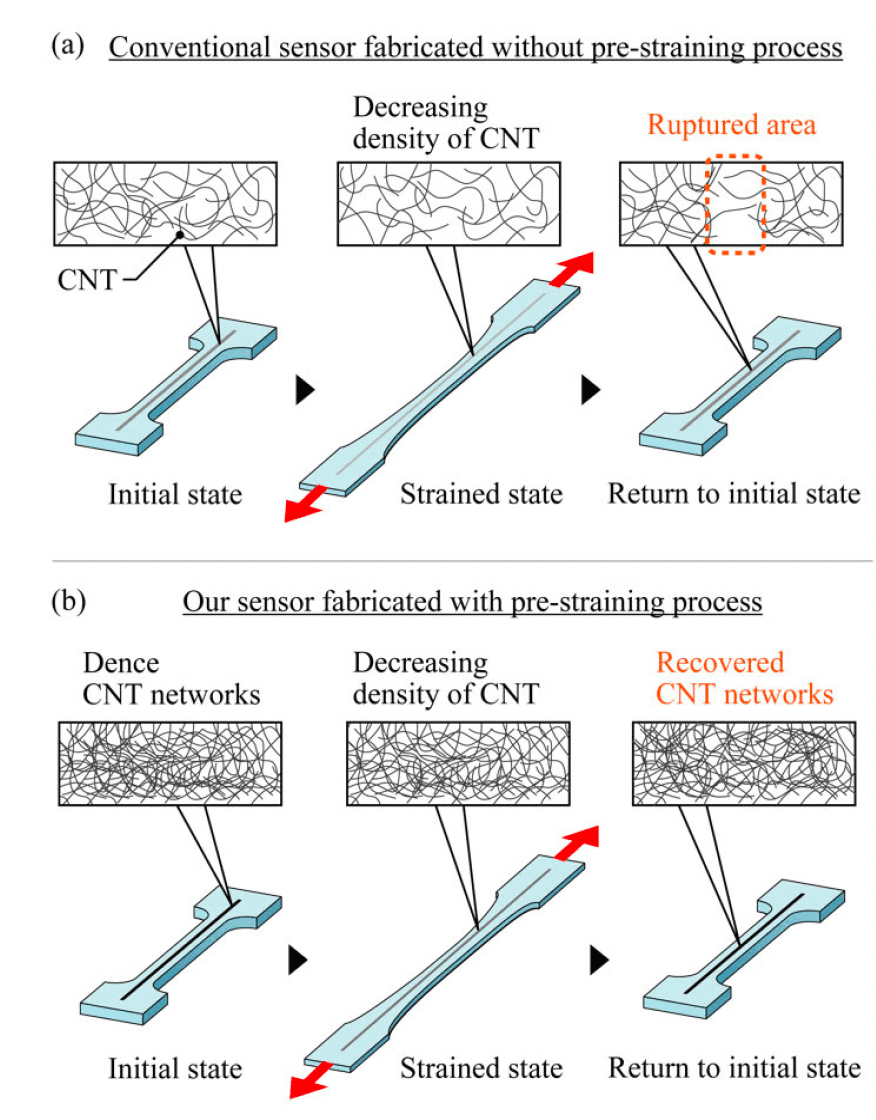
In this study, we propose a pre-strain method to achieve a linear strain–resistance response by controlling the initial structure of the CNT (carbon nanotube) network.
The fabrication process is as follows:
- The elastomer substrate is pre-stretched in one direction
- CNT powder is applied onto the stretched surface
- The substrate is released back to its original (zero-strain) state
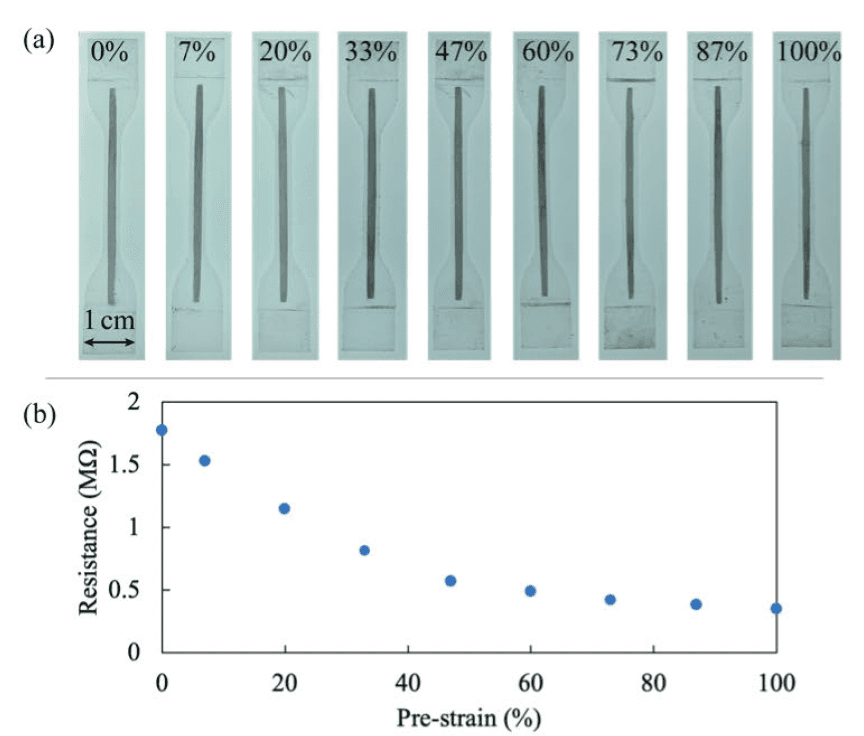
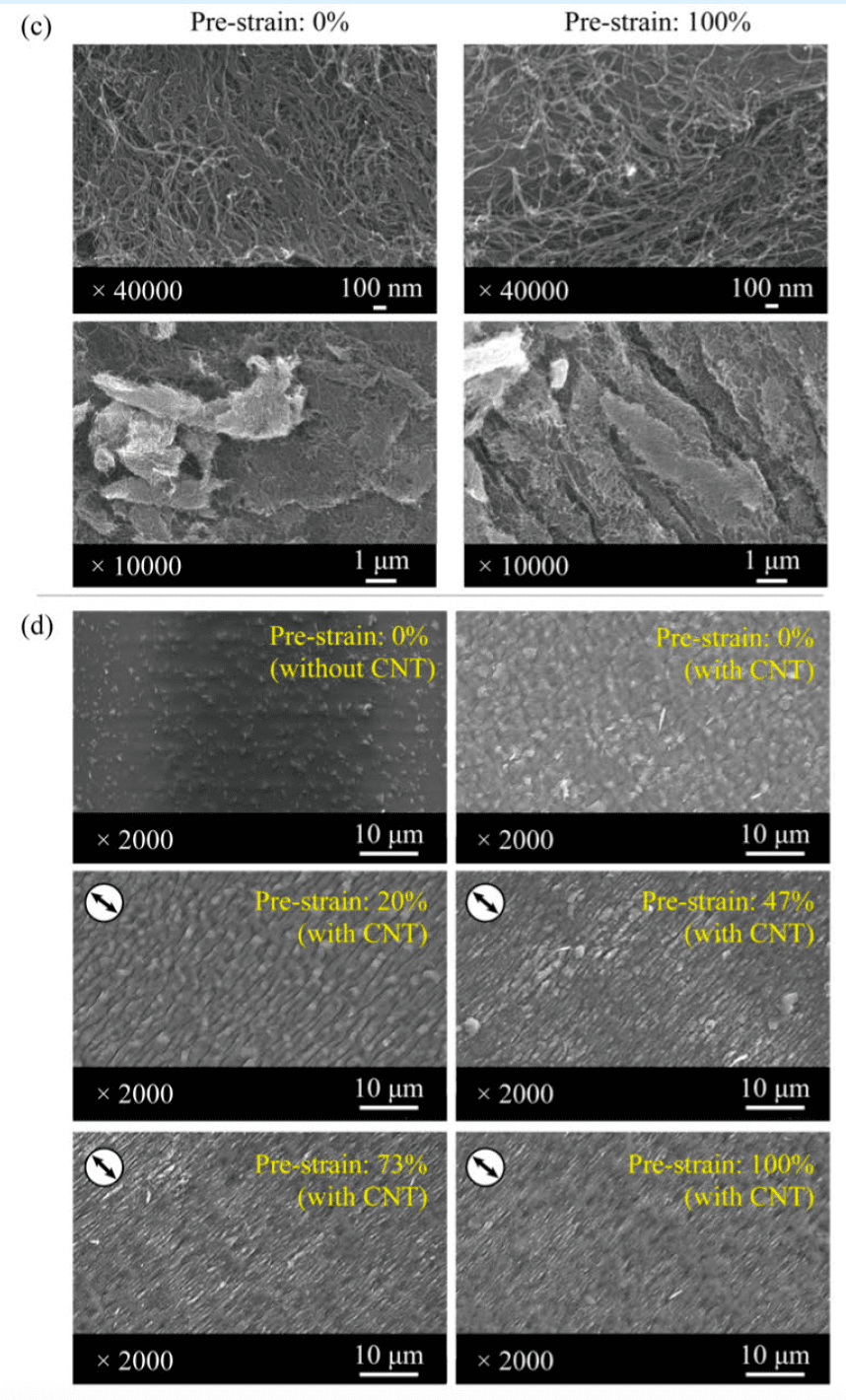
This process aligns CNT agglomerates and increases their density, thereby strengthening the conductive network. As a result, network rupture is suppressed and a stable resistance response is achieved.
Material
An acrylic elastomer with low hysteresis is used as the substrate. Compared to conventional elastomers, this material exhibits smaller hysteresis and faster recovery, enabling stable sensing under dynamic deformation.
Additionally, the use of CNT powder with a simple coating process allows fabrication without specialized equipment, contributing to a low-cost and scalable approach.
Result
The proposed method achieves the following characteristics:
- A constant gauge factor (GF ≈ 1.46) in the strain range of 0–100%
- High linearity with low variation in resistance change
- Stable reference resistance under repeated deformation
These results significantly improve the nonlinear behavior and drift observed in conventional CNT-based sensors.
Application
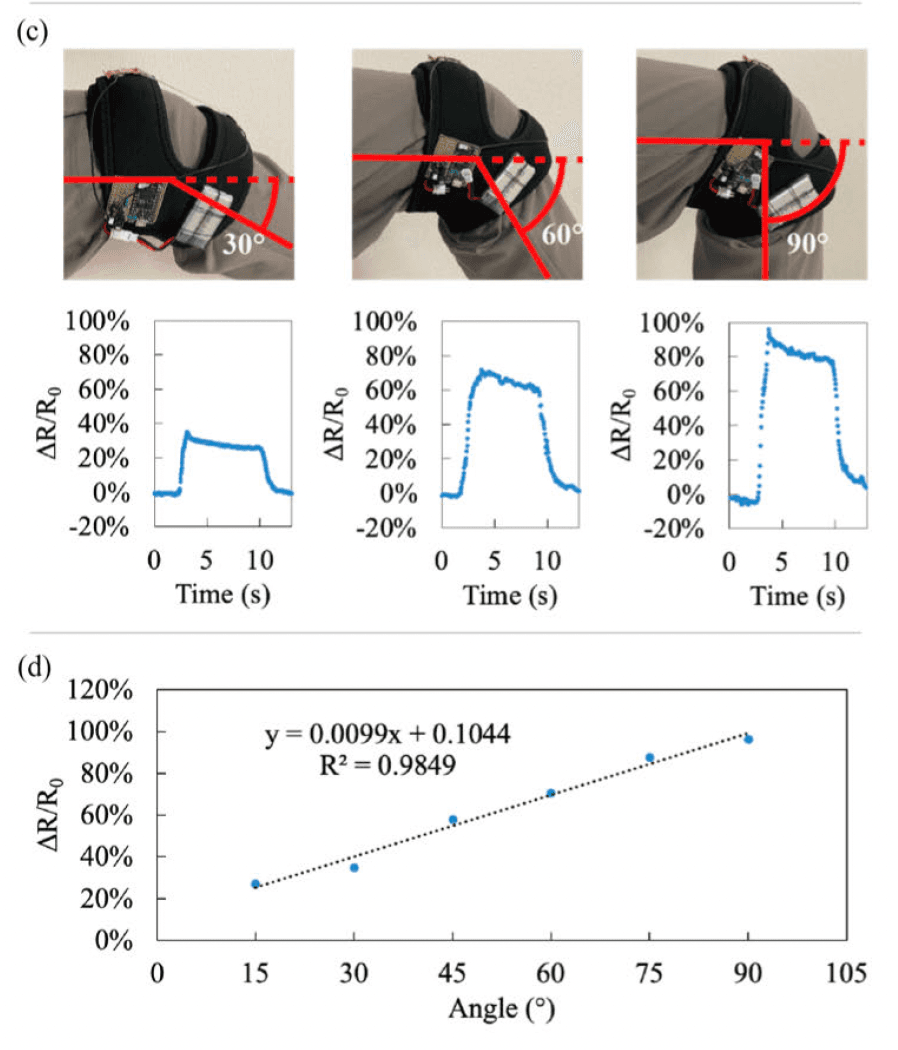
The developed sensor was applied to knee motion detection.
- A linear response corresponding to joint angle was obtained
- The sensor successfully distinguished walking and running motions
- Stable and repeatable responses were confirmed under dynamic conditions
Conclusion
By optimizing the CNT network using the pre-strain method, this study achieves:
- Resolution of the nonlinearity issue in resistive strain sensors
- High-accuracy sensing without calibration
- A simple and reproducible fabrication method
This approach provides a promising pathway for reliable soft strain sensors in wearable devices and soft robotics.