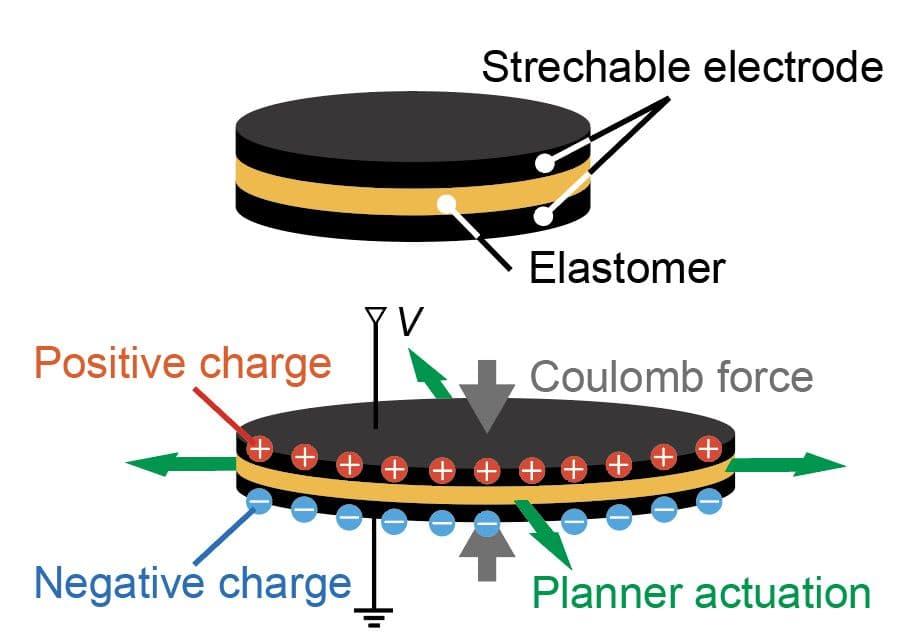
Electrostatic soft actuator
Dielectric Elastomer Actuators
Overview
Dielectric elastomer actuators (DEAs) represent a class of soft actuators that utilize the principles of electrostatics and material elasticity to convert electrical energy into mechanical motion. They are composed of a dielectric elastomer membrane sandwiched between two compliant electrodes. When a voltage is applied across the electrodes, the resulting electric field induces electrostatic forces that compress the elastomer, leading to significant strain and deformation. DEAs are highly regarded for their lightweight, flexibility, and capability for large deformation, making them an attractive option for a variety of applications in soft robotics, artificial muscles, and adaptive structures.
Mechanism
The functioning of dielectric elastomer actuators is predicated on the interplay of electrostatics and elastomer material properties. Here's a breakdown of the mechanism:
-
Material Composition: DEAs typically use polymers, such as silicone or acrylic elastomers, which have high dielectric constants. The elastomer is sandwiched between compliant conductive layers, usually made from carbon-based materials or metallic coatings.
-
Electric Field Application: When a voltage is applied across the electrodes, an electric field is generated within the elastomer. This field causes the charges in the electrodes to polarize, creating an electrostatic attraction that compresses the elastomeric layer.
-
Mechanical Response: The electrostatic forces acting on the elastomer result in biaxial deformation, which manifests as stretch and contraction. The actuator's shape can change significantly, allowing for various mechanical outputs (e.g., bending, twisting, and linear movement).
-
Energy Exchange: The conversion of electrical energy to mechanical energy is effective due to the high energy density of DEAs. They can achieve large strains (often over 100% strain), making them suitable for applications requiring extensive movement or force generation.
Applications
Dielectric elastomer actuators have found diverse applications across multiple fields due to their unique mechanical properties:
-
Soft Robotics: DEAs are employed in soft robotic grippers and limbs, mimicking biological motion and enabling delicate manipulation of objects. Their flexibility allows them to adapt to various shapes and sizes, enhancing dexterity in robotic applications.
-
Artificial Muscles: DEAs are often referred to as "artificial muscles" in biomimetic designs. They can generate movement that closely resembles natural muscle contractions, providing potential solutions for assistive devices and prosthetics.
-
Adaptive Structures: In the field of smart materials, DEAs can be incorporated into structures that require active deformation in response to environmental factors. This includes applications in adjustable lenses, variable airflow in HVAC systems, and shape-changing surfaces in aerospace.
-
Energy Harvesting: DEAs also have potential in energy harvesting applications, where they can convert mechanical motion (e.g., vibrations or pressure changes) back into electrical energy, creating a self-powered system in wearable devices or sensors.
-
Medical Devices: Within medical technology, DEAs can be used for responsive components in devices such as advanced breathing masks or surgical robots, where precision and flexibility are paramount.
Conclusion
Dielectric elastomer actuators are at the forefront of soft actuator technology, enabling a wide array of applications due to their unique blend of electro-active properties and versatility in mechanical output. Their continued development promises advancements in fields ranging from robotics to biomedical engineering, making them a critical area of research and innovation in future technology landscapes. As material science and engineering progress, the full potential of DEAs will likely be unlocked, leading to novel solutions and improvements in performance across diverse applications.