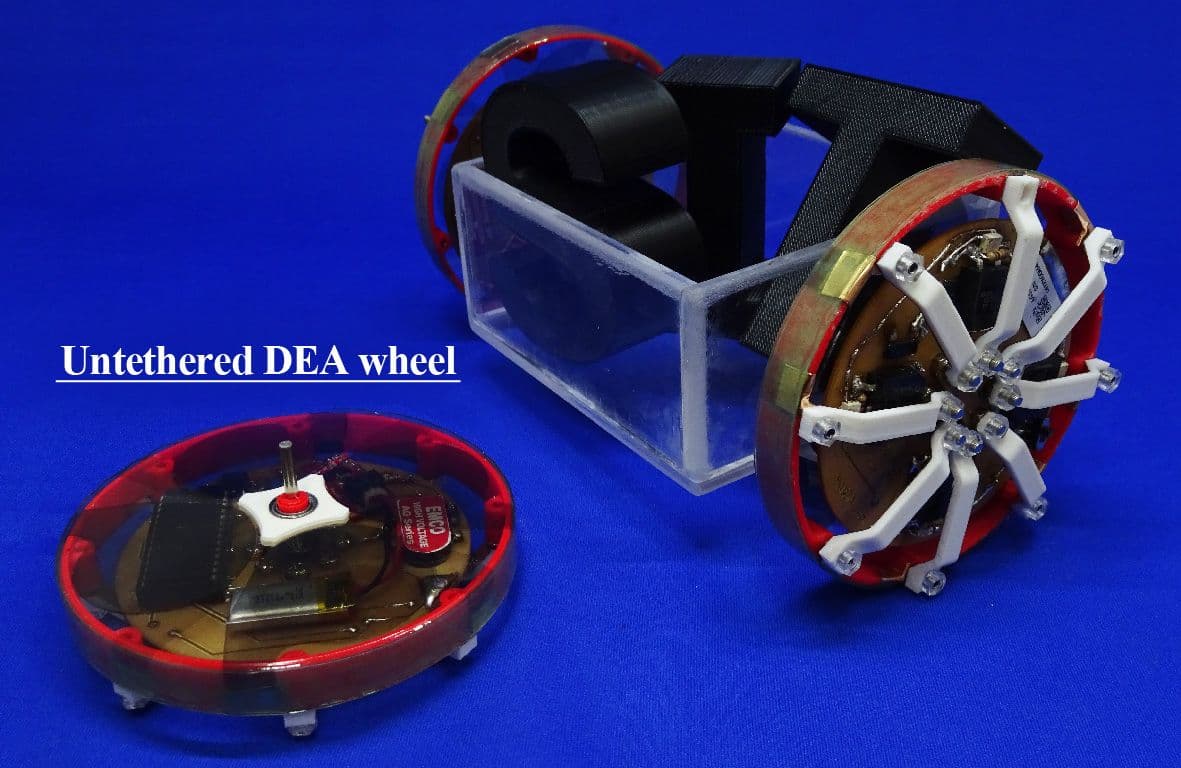
Untethered rotational system with DEA
DEA Wheel
Overview
The DEA wheel, or the Dynamic Energy Absorption wheel, represents a significant advancement in vehicular safety and performance technologies. Originally conceptualized for effective shock absorption and energy management, the DEA wheel integrates innovative materials and design principles to optimize vehicle handling, durability, and passenger comfort. Its utility spans automotive, aerospace, and specialized industrial applications, making it a subject of growing academic and commercial interest.
Mechanism
The operation of the DEA wheel is founded on dynamic energy absorption principles. Unlike conventional wheels that primarily rely on tire elasticity and suspension systems for impact mitigation, the DEA wheel uses a multi-layered construction composed of advanced polymers, composite materials, and embedded damping modules.
When an external force, such as a road bump or impact, is exerted on the wheel, the built-in energy absorption system activates. The following sequence occurs:
- Initial Contact: The outer composite shell distributes the force over a broader area, reducing peak stress at any single point.
- Energy Absorption: The internal layers, often consisting of viscoelastic polymers, deform and dissipate kinetic energy into heat or mechanical work.
- Restoration: After absorbing the impact, the materials quickly revert to their original state, ready for subsequent energy inputs.
- Feedback: Some designs incorporate sensors and actuators to provide real-time feedback for adaptive damping and enhanced control.
This mechanism results in reduced vibrations transferred to the vehicle body, prolonged wheel lifespan, and improved overall safety.
Key Features
The DEA wheel is distinguished by several key features:
- Superior Shock Absorption: Utilizes layered construction and advanced materials for efficient energy dissipation.
- Enhanced Durability: Resistant to fatigue and damage, even under high stress or repeated impacts.
- Adaptive Response: Certain DEA wheels integrate sensor-based systems, enabling real-time adjustment of damping characteristics.
- Lightweight Design: The use of composites reduces overall unsprung mass, potentially improving fuel efficiency and handling.
- Versatile Applications: Applicable in various domains—including passenger vehicles, aerospace landing gears, and off-road industrial machinery.
- Maintenance Reduction: The inherent robustness of the DEA wheel minimizes wear and routine maintenance needs.
In summary, the DEA wheel exemplifies the fusion of material science and engineering, orienting vehicular design towards enhanced safety, efficiency, and adaptability. Ongoing research and development are likely to further broaden its applications and effectiveness in the near future.