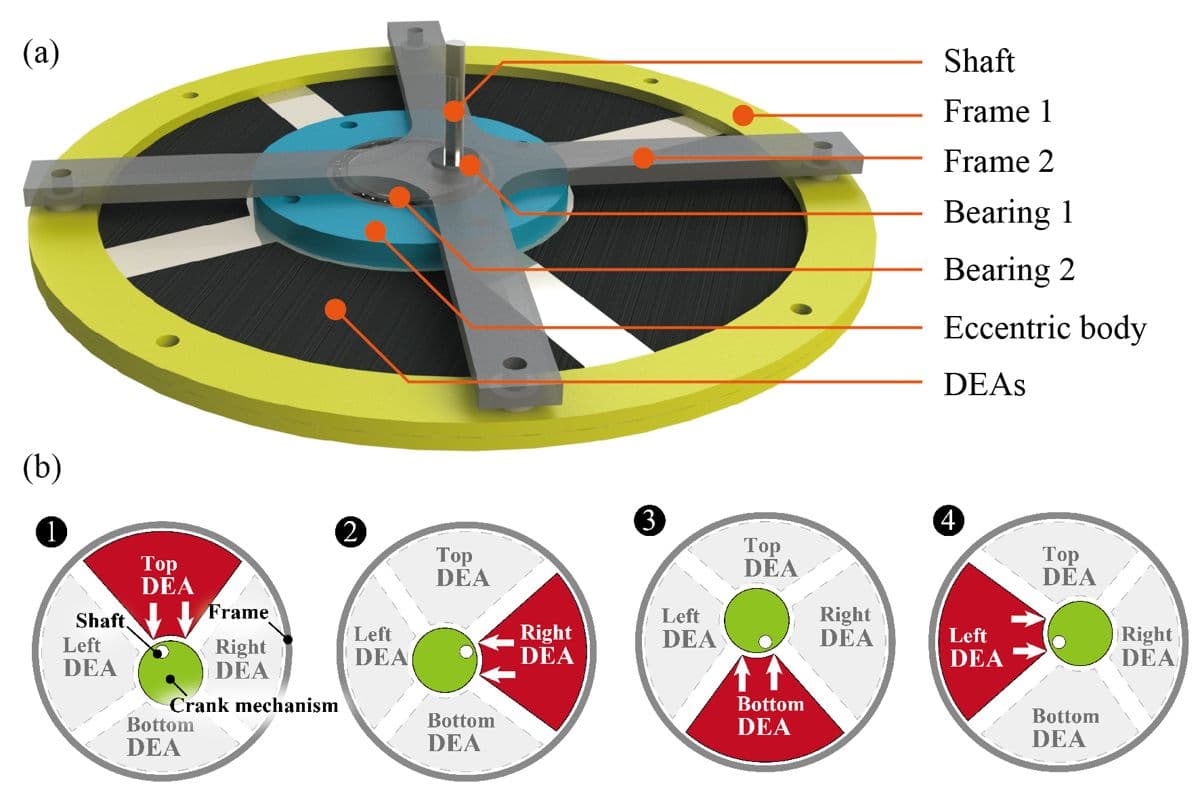
Rotational motor driven by DEA
DEA Motor
Overview
A Dielectric Elastomer Actuator (DEA) motor is an advanced electromechanical device that converts electrical energy into mechanical motion using dielectric elastomer materials. Dielectric elastomers are a category of soft, compliant polymers known for their exceptional ability to undergo large deformations when an electric field is applied. DEA motors stand out for their lightweight construction, high energy density, and potential to provide bio-inspired, muscle-like actuation. This makes them attractive for applications in robotics, soft automation, adaptive optics, and prosthetics.
Mechanism
The working principle of a DEA motor is rooted in the unique electromechanical properties of dielectric elastomers. Typically, a DEA structure consists of a thin elastomeric film sandwiched between two compliant electrodes. When a voltage is applied across the electrodes, electrostatic forces compress the elastomer in the thickness direction while causing expansion in the planar directions due to the material’s incompressibility. This deformation can be translated into useful mechanical work.
To create rotational or linear motion, DEA motors employ various configurations:
- Stacked, rolled, or planar layouts translate film deformation into fixed displacement or oscillatory movement.
- Multiple DEA elements can be arranged in sequence or coordinated by a control system for enhanced torque or bandwidth.
- Compliant mechanical frames or linkages often guide and magnify the generated strain into the desired output motion.
Furthermore, advanced designs may incorporate feedback systems for precise motion control, enabling the DEA motor to perform complex tasks in dynamic environments.
Key Features
DEA motors exhibit several distinctive features, including:
- High Energy Density: DEA motors provide a large specific actuation force relative to their weight, often surpassing comparable electromagnetic actuators.
- Large Strain Capability: They can undergo stretches of up to 300% or more, offering exceptional flexibility and range of motion.
- Lightweight and Flexible: Constructed primarily from soft polymers, DEA motors are significantly lighter and more compliant than rigid alternatives.
- Silent Operation: The lack of rigid, friction-based components results in nearly silent performance, suitable for noise-sensitive applications.
- Fast Response: Under optimized conditions, DEA motors can achieve high actuation frequencies, supporting rapid and dynamic movements.
- Bio-Inspired Potential: The actuation mechanism closely resembles natural muscle action, making DEA motors especially suitable for biomimetic devices.
- Simple Construction: The fundamental design is relatively straightforward, aiding miniaturization and integration into soft systems.
Despite their promise, DEA motors also face challenges, notably high operating voltages, susceptibility to long-term material fatigue, and environmental sensitivity. Ongoing research aims to address these limitations and unlock the full potential of dielectric elastomer actuator motors in future electromechanical systems.